

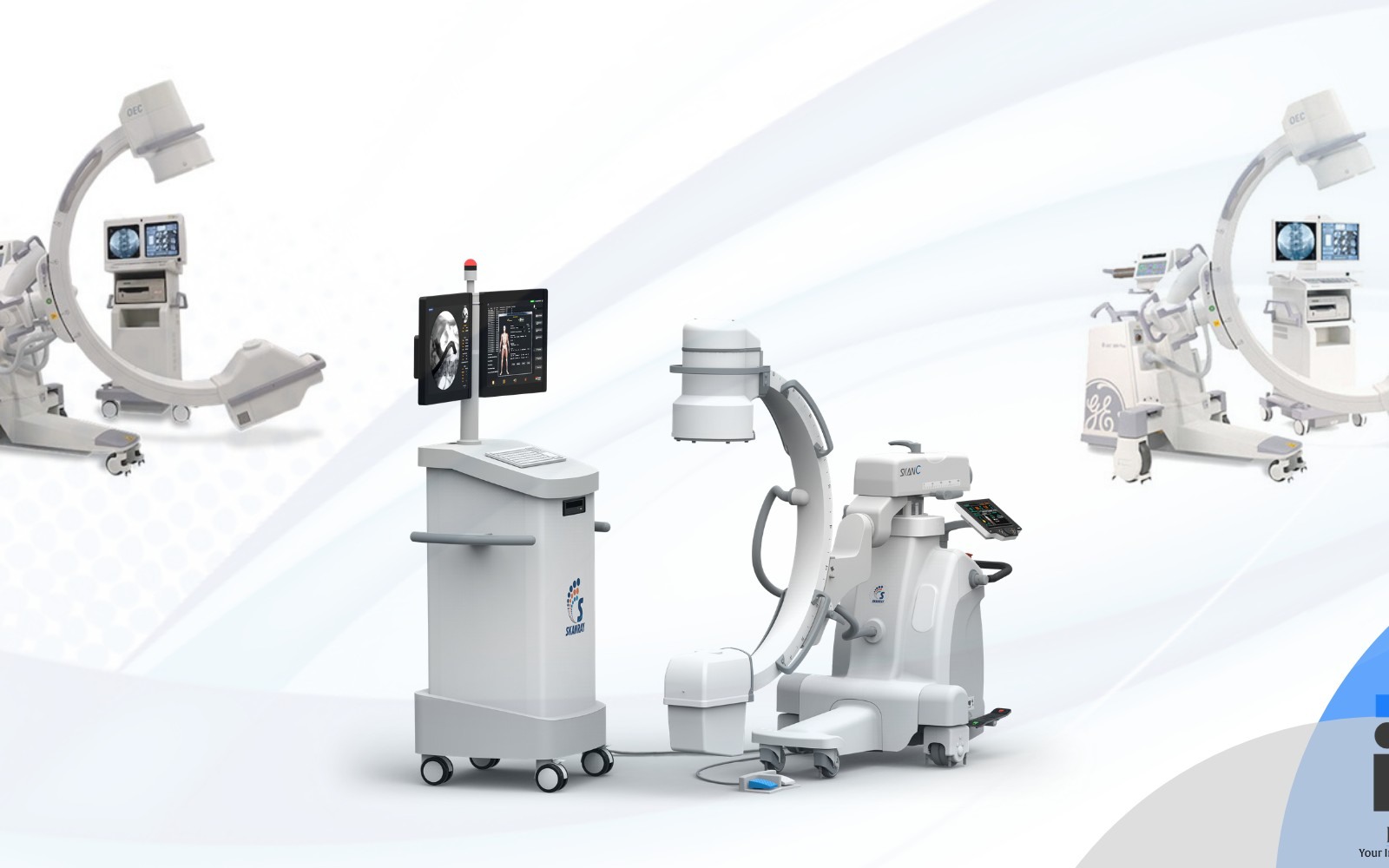
Fixed C-arms mount to the ceiling or floor in a dedicated room rather than rolling between suites on a cart. That permanent installation makes them the right configuration for catheterization labs, dedicated vascular procedure rooms, hybrid ORs, and high-volume interventional suites where a mobile unit would spend most of its life in one place anyway. The ceiling-mounted or floor-mounted geometry lets the arm sweep through a wider range of angulation than any wheeled unit can achieve, which is why fixed configurations dominate in cardiac cath labs and complex vascular interventional settings.
Price points for fixed C-arm configurations run from approximately $300,000 for a single-plane refurbished system to well over $1,000,000 for a new biplane interventional suite. Those capital requirements make financing standard practice rather than the exception, and structuring the payment correctly for a high-revenue procedural suite is where the real planning value lies. We finance fixed C-arm installations across that full price range, starting at $50,000, with application-only approvals available to approximately $400,000 and full financial underwriting for larger transactions.
Fixed C-Arm Configurations: Single-Plane and Biplane
Single-plane fixed C-arms position one X-ray tube and one detector array in a fixed room, providing high-quality fluoroscopic and radiographic imaging in one plane at a time. The system pivots around the patient to achieve different projection angles, but only one imaging plane runs at a time. Single-plane systems serve most cardiac catheterization, peripheral vascular, and neurointerventional procedures adequately, particularly when a skilled operator uses the isocentric rotation to reconstruct three-dimensional anatomy from multiple two-dimensional acquisitions.
Biplane systems run two C-arm configurations simultaneously, one anteroposterior and one lateral, allowing real-time two-plane visualization without switching tube positions. This is the standard configuration for complex neurointerventional procedures like coiling of cerebral aneurysms, arteriovenous malformation treatment, and pediatric cardiac catheterization where simultaneous multiplane views are not optional. Biplane systems carry significantly higher price points, often $800,000 to $1,500,000 for a new complete room with radiation shielding and table.
For programs adding their first fixed interventional room, a single-plane system from manufacturers like Siemens Healthineers or Philips Healthcare typically delivers the right capability at a manageable capital commitment. For neurointerventional programs, the biplane investment is typically unavoidable.
How Fixed C-Arm Financing Works
Fixed C-arm financing usually includes the imaging system, room shielding, ceiling suspension hardware, table, and installation. Separating those components across multiple vendors and financing sources creates unnecessary complexity. Bundling the total project cost into one facility and equipment loan simplifies the deal structure and often reduces the total financing cost compared to piecemealing components through different capital sources.
For transactions above $400,000, which includes most new fixed C-arm rooms, we move to full financial underwriting. Three months of bank statements and business tax returns are the core documentation. Hospital systems and larger ASC groups with strong financials typically move through underwriting efficiently. Independent cardiology or vascular practices may need a personal guarantee or additional financial history depending on practice age and revenue scale.
Lease structures are also available for fixed C-arms, including medical imaging equipment financing arrangements designed for complex multi-component installations. Some hospital finance departments prefer lease treatment for capital budgeting reasons, while others prefer loan structures that eventually produce an owned asset. We structure both.
Refinancing an Existing Fixed C-Arm Suite
Fixed C-arm suites that were purchased outright or financed several years ago may hold significant remaining value. For a hospital or specialty practice that needs operating capital or wants to fund a different capital project, a Sale-Leaseback Financing on an installed interventional suite converts that equipment equity into cash. The facility continues using the room without interruption while the lender assumes ownership, and the monthly payment replaces the tied-up capital.
Refinancing an existing loan balance also works for programs mid-term on a high-rate loan taken during a period of constrained credit. If rates or the credit profile have improved, refinancing to a lower payment frees cash flow. Equipment appraisal is required to establish current market value, and the remaining useful life of the imaging chain factors into term length. Older image intensifier-based fixed rooms may have limited remaining financing life even if the equipment still functions clinically.
Programs considering a major upgrade from image intensifier to flat-panel flat-detector should also explore equipment refinancing as a bridge strategy: refinancing the current room to generate cash toward the down payment on the new system while extending operating life on the existing asset.
Fixed C-Arms in the Interventional Market
The shift of cardiovascular and neurointerventional procedures from inpatient hospital settings toward hospital outpatient departments and free-standing ambulatory facilities has driven demand for fixed C-arm rooms outside traditional hospital walls. Many cardiology practices now operate their own catheterization labs in office-based settings, and the financing of those rooms follows the same underwriting logic as any major equipment acquisition. The key metric is expected procedure volume and the reimbursement per case relative to the monthly payment obligation.
Interventional radiology programs, whether hospital-based or free-standing, also account for substantial fixed C-arm demand as IR physicians take on more complex peripheral vascular, oncological, and image-guided procedures. For those programs, the capital commitment to a fixed IR suite is justified by procedure revenue that a mobile unit simply cannot support at the same imaging quality level.
Related Financing Paths
Questions about Fixed C-Arms Financing
Clear answers on equipment eligibility, documentation, timing, and the financing path before you send the full file.
Can you finance a fixed C-arm room that includes both the equipment and the lead-lined room buildout?
Yes. We package the imaging system, room shielding, ceiling suspension, procedural table, and installation into a single facility financing deal. A combined project loan avoids splitting costs across two separate credit processes and often produces better total terms.
A hospital is purchasing the system but an independent physician group is providing the professional component. Who is the borrower?
The borrower is whichever entity owns or leases the physical space and takes title to the equipment. In a joint venture or co-management structure, the legal and financial relationship between the hospital and the physician group needs to be defined before structuring the financing. We can accommodate ownership structures where the physician group owns the equipment and the hospital pays a facility fee.
Does a biplane system qualify for the same lease structures as a single-plane unit?
Yes, though biplane systems typically require full financial underwriting given their price points. The lease structure, whether fair market value or dollar-buyout, follows the same logic regardless of plane count. Lease term alignment with the system's expected upgrade cycle matters more for biplane rooms, given the significant capital exposure.
Our existing fixed C-arm is 12 years old. Can we do a sale-leaseback on it?
A 12-year-old fixed C-arm has likely depreciated significantly. Whether a sale-leaseback is practical depends on the specific system, its current market value, and whether the imaging chain has been recently upgraded. An independent appraisal would establish what the leaseback could generate. Systems with modern flat-panel detectors added in recent years often retain more value than the original installation date suggests.
Can we include a second mobile C-arm in the same financing as a fixed room build?
Yes. Bundling a mobile C-arm for supplemental procedural use with the fixed room installation into one deal is common. We structure both assets under a single credit approval, which simplifies documentation and produces one closing instead of two.
Bring this system into your room.
Send the Fixed C-Arms Financing quote, seller details, requested amount, and installation target. The imaging finance desk will map the next practical step.