

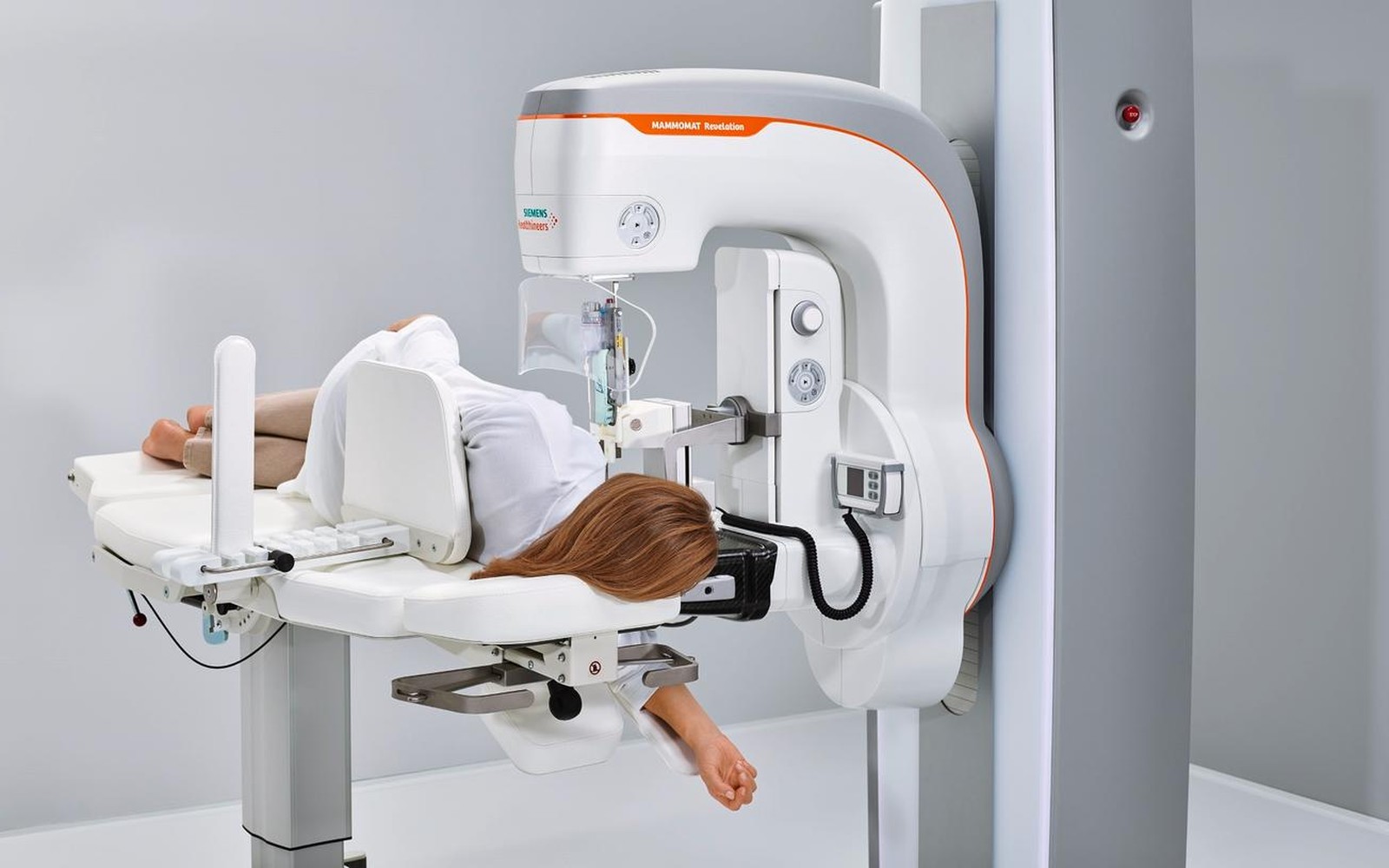
Stereotactic breast biopsy brings an interventional procedure into the mammography room rather than sending patients to a separate facility or the operating room for an open biopsy. The system uses two oblique X-ray projections to calculate the three-dimensional coordinates of a target lesion within the compressed breast, then guides a biopsy needle or vacuum-assisted probe to that precise location for sampling. For mammography programs that identify suspicious calcifications or soft tissue findings and currently refer those patients out for biopsy, capturing that procedure in-house changes the revenue picture substantially.
Dedicated prone stereotactic biopsy tables from Hologic and similar manufacturers run from approximately $180,000 to $350,000 new. Upright attachment systems that mount to existing mammography units offer a lower-cost path to stereotactic capability. Refurbished prone biopsy tables are available and represent a viable entry point for programs adding this service without the full capital commitment of a new system. We finance stereotactic biopsy systems starting at $50,000, with application-only approvals available up to approximately $400,000 and vendor closing after imaging-package review.
Prone Tables versus Upright Attachment Systems
Prone stereotactic biopsy tables position the patient face-down on a padded platform with a cut-out through which the breast hangs freely below the table surface. The mammography detector and tube rotate around the breast from beneath the table, acquiring stereo projections without the patient seeing the needle. Patient tolerance and cooperation are generally excellent with prone positioning, and the technique allows the radiologist to work unobstructed from below.
Upright attachment systems mount a stereotactic biopsy arm to a standard mammography unit, converting the diagnostic platform into a biopsy-capable system. The patient sits or stands during the procedure rather than lying prone. Upright systems cost significantly less than a dedicated prone table, but the procedure environment requires more careful patient preparation to minimize vasovagal response. For programs with limited budget or space, an upright attachment system on an existing mammography unit is a reasonable first step into stereotactic biopsy without the capital requirement of a separate prone table.
The choice between prone and upright also affects lesion access. Posterior lesions close to the chest wall are more accessible in some patients with prone positioning; very thin patients or patients with small breast volume sometimes present access challenges regardless of configuration. Consultation with a breast radiologist about your expected patient population and lesion types should inform the configuration decision before committing to either system.
Programs That Benefit From In-House Stereotactic Biopsy
Any mammography program with consistent recall and suspicious calcification findings is a candidate for stereotactic biopsy. The question is whether current referral volume justifies bringing the procedure in-house versus continuing to send patients to a hospital or breast center. A program performing 20 or more biopsies per year that currently refers all stereotactic cases is generating significant procedure revenue for another facility and potentially losing those patients' downstream follow-up and surveillance imaging as well.
Independent outpatient imaging centers with active mammography programs are the most common buyer. Breast imaging subspecialty practices that built their volume on tomosynthesis screening and now want to complete the breast imaging service line by adding biopsy are the next largest segment. For those practices, the biopsy system is often purchased simultaneously with or shortly after the tomosynthesis upgrade.
Hospital-based breast programs adding outpatient biopsy capacity to reduce main-campus scheduling backlogs also finance stereotactic systems. An outpatient breast imaging suite that can perform same-week biopsy reduces patient anxiety and improves the care continuum that referring physicians value when building referral relationships. The women's health and OB/GYN clinics that are primary referral sources for breast imaging programs strongly prefer same-site biopsy availability for their patients.
Financing a Stereotactic Biopsy System
Stereotactic biopsy system financing follows the same structure as other medical imaging equipment loans and leases. For purchases under $400,000, application-only approval is the standard path. For upright attachment systems running about $80k to $150k, the transaction is typically straightforward and quick. Prone table acquisitions landing between $200k and $350k may fall within application-only limits depending on the specific system and configuration. Application-only financing is available for most stereotactic biopsy acquisitions and keeps the process moving fast.
Loan terms of 48 to 72 months are appropriate for stereotactic biopsy systems. The system's useful life depends on mechanical wear on the motorized biopsy stage and continued manufacturer support for the guidance software. Programs that plan to upgrade their mammography platform in five to seven years might time the biopsy system acquisition to align with that broader platform update. X-ray equipment leasing is a practical structure when you want to preserve upgrade optionality at term end.
If you are financing a stereotactic biopsy attachment for an existing mammography unit that you are also upgrading to tomosynthesis capability simultaneously, combining both transactions into a single equipment loan simplifies the process. We finance complete breast imaging room upgrades that include the base mammography system, the tomosynthesis option, and the stereotactic attachment under one deal. The combined transaction is often more efficient than financing three components separately. Related reading on medical imaging equipment financing covers the options for bundled transactions.
Related Financing Paths
Stereotactic biopsy capability is closely related to ultrasound-guided biopsy for soft tissue lesions that are sonographically visible. Programs that add stereotactic capability often also consider adding ultrasound-guided biopsy capability, which requires a capable ultrasound system and a probe configured for biopsy guidance rather than a separate imaging platform. We finance ultrasound equipment as well as mammography and stereotactic systems, and bundling both in a single application covers the full breast biopsy service line.
For programs that want to add MRI-guided biopsy capability in the longer term, the capital requirements and room design are substantially different. That is a separate conversation. In the near term, stereotactic and ultrasound-guided biopsy together cover the large majority of breast biopsy indications without requiring MRI biopsy infrastructure. Starting with those two pathways and adding MRI biopsy access through a hospital partner or referring relationship is a practical sequencing strategy for most independent programs.
Also relevant: 3D tomosynthesis mammography systems are the detection partner to the stereotactic biopsy workflow. The tomosynthesis system identifies the calcification cluster or suspicious density; the stereotactic system localizes and samples it. Financing both together makes sense when both are being added to the practice simultaneously.
Questions about Stereotactic Breast Biopsy Systems Financing
Clear answers on equipment eligibility, documentation, timing, and the financing path before you send the full file.
Can I finance a stereotactic biopsy system for a practice that is still adding its tomosynthesis unit? Do we need the mammography system established first?
No, you do not need the tomosynthesis unit already in place to finance the biopsy system. Both can be financed simultaneously under a single application, or the biopsy system can be structured as a separate transaction on its own timeline. Many practices open both capabilities at the same time as part of a comprehensive breast imaging program launch.
Is an upright stereotactic attachment on an existing mammography unit financeable as a separate add-on?
Yes, provided the attachment cost meets the $50,000 minimum. The attachment invoice serves as the equipment documentation, and the financing is structured as a standalone transaction independent of the mammography system it attaches to. Terms depend on the attachment cost and the practice's credit profile.
What documentation does a busy breast center with five years of history need to provide?
For a purchase under $400,000, application-only approval is available, which means no financial statements are required. For transactions above that threshold, three months of bank statements and the most recent business tax return are the primary documents. A five-year operating history with consistent revenue is a strong foundation for approval.
Our prone biopsy table is eight years old and is paid off. Is it worth doing a sale-leaseback or just running it to end of life?
An eight-year-old prone biopsy table's residual market value depends on the model, condition, and service history. Tables from the first generation of digital-guided systems may have limited resale value; newer models retain more. We can assess whether a sale-leaseback generates meaningful capital relative to the system's current value. If the value is modest, running the equipment to end of life and financing a new system when replacement is needed may be cleaner.
Bring this system into your room.
Send the Stereotactic Breast Biopsy Systems Financing quote, seller details, requested amount, and installation target. The imaging finance desk will map the next practical step.